Independent journalism on Jharkhand’s politics, economy and society.

What Are MLC Elections, and Why Doesn’t Jharkhand Have a Legislative Council or Vidhan Parishad?

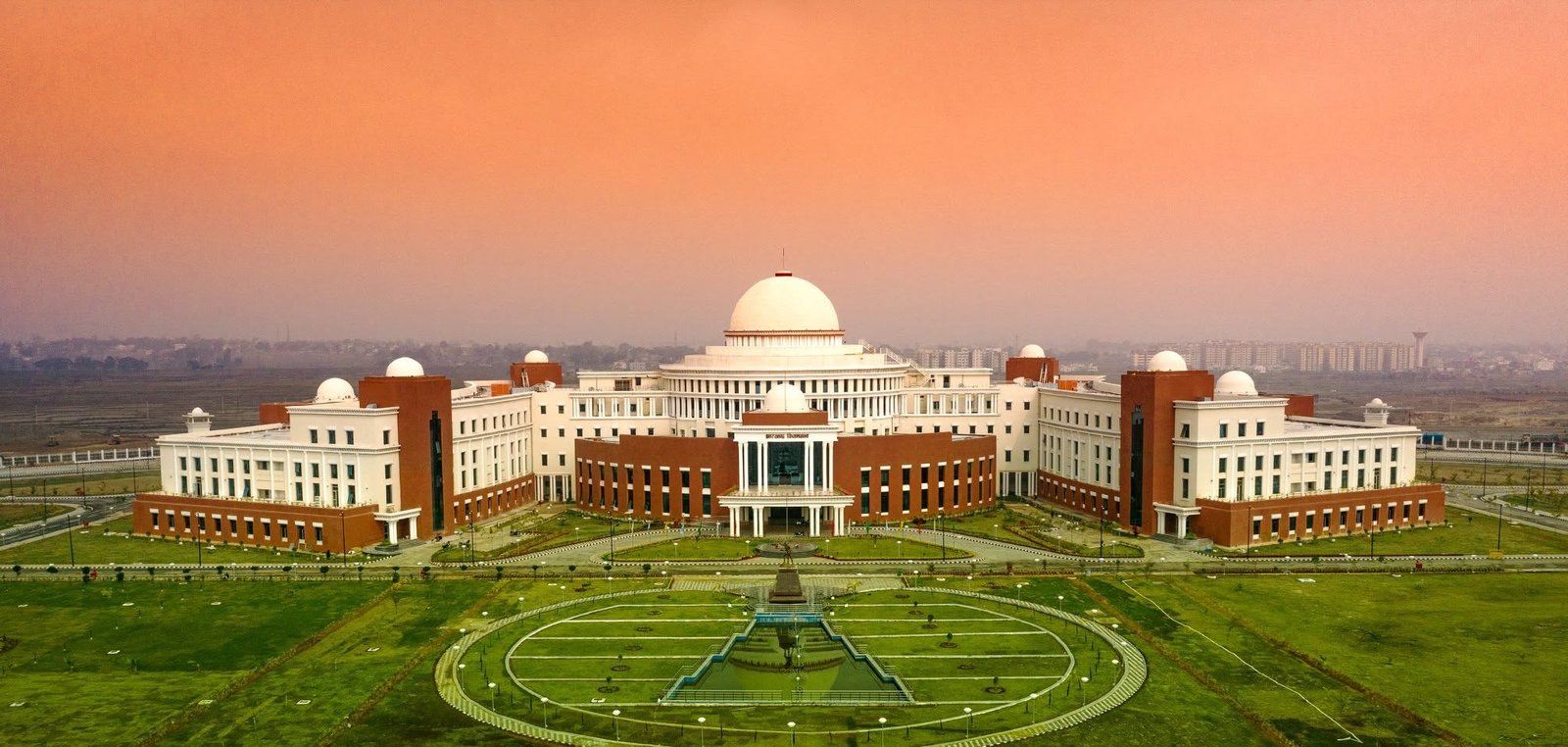
Summary: While voters in four states recently elected Members of Legislative Councils, Jharkhand continues to have a single-house legislature. In this Explainer, we explore the basics of MLC elections and their constitutional arrangement, one that raises an interesting question about what it would take for Jharkhand to have a Vidhan Parishad of its own.
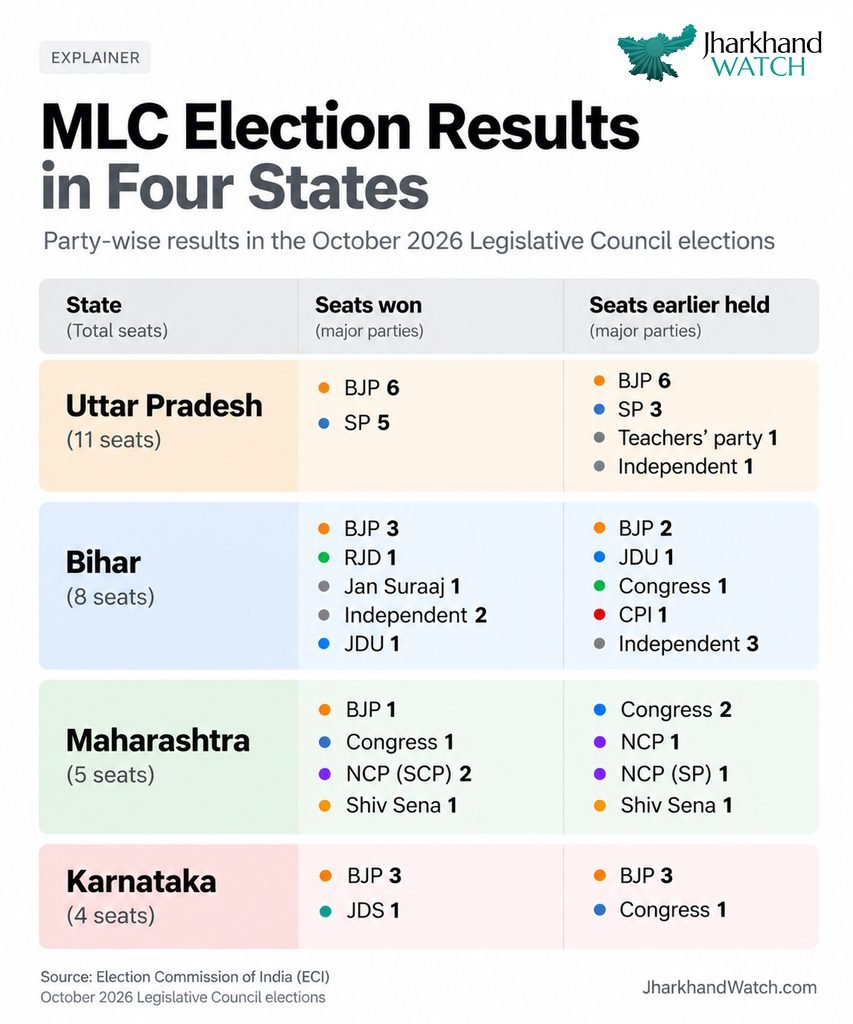
Elections to 28 Legislative Council (Vidhan Parishad) constituencies across Uttar Pradesh, Bihar, Maharashtra, and Karnataka were held on October 29, 2026. These included separate constituencies for graduates and teachers, allowing eligible voters from these groups to elect representatives to their respective state Legislative Councils.
Here are major highlights from the MLC Elections:
But without going much into political dimensions, today we are exploring why some states have MLC elections while Jharkhand does not. The answer lies in how India’s Constitution allows states to organise their legislatures.
What exactly is an MLC?
An MLC, or Member of Legislative Council, is a member of a state’s upper legislative house, known as the Vidhan Parishad. The lower house is called the Legislative Assembly or Vidhan Sabha, whose members are known as MLAs.
A state legislature with only one house has a unicameral system. One with two houses has a bicameral system.
Article 168 of the Constitution provides for both arrangements. Currently, six states have Legislative Councils: Andhra Pradesh, Bihar, Karnataka, Maharashtra, Telangana and Uttar Pradesh. Other states, including Jharkhand, have only a Legislative Assembly.
Unlike MLAs, who are directly elected by voters from territorial constituencies, MLCs enter the Council through different electoral and nomination routes.
Five routes to the Legislative Council
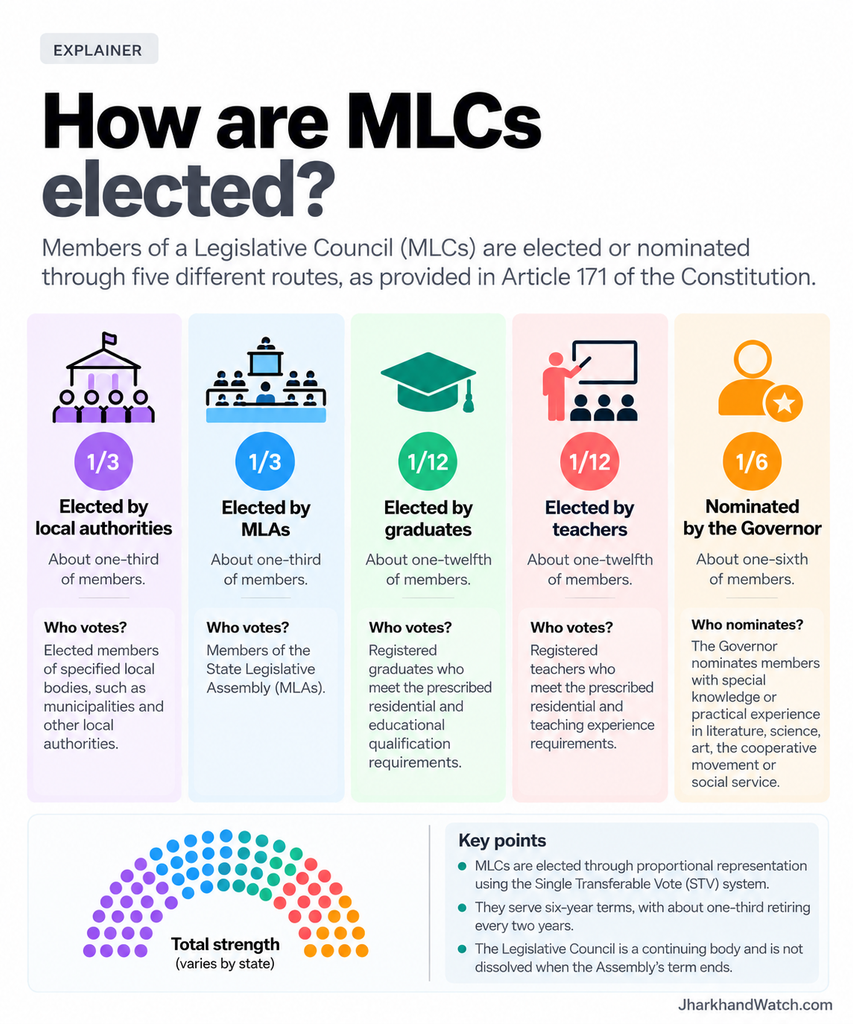
Article 171 of the Constitution provides for five categories of membership in a Legislative Council:
- Local authorities: Approximately one-third of the members are elected by representatives of specified local bodies, such as municipalities and other local authorities. These voters are members of the relevant local bodies, not the general public.
- Members of the Legislative Assembly: Approximately one-third are elected by MLAs. Members of Parliament and ordinary voters do not participate in this election.
- Graduates: Approximately one-twelfth are elected by registered graduates’ constituencies. Eligible voters must ordinarily reside in the constituency and have held a recognised graduate qualification for at least three years before the qualifying date.
- Teachers: Approximately one-twelfth are elected by registered teachers’ constituencies. Eligible voters must ordinarily reside in the constituency and have taught for a total of at least three years during the six years immediately preceding the qualifying date in specified educational institutions.
- Governor’s nominees: The remaining one-sixth are nominated by the Governor. These members should have special knowledge or practical experience in literature, science, art, the cooperative movement or social service.
The graduate and teacher constituencies are therefore not open to everyone with a degree or anyone working as a teacher. Voters must satisfy the prescribed legal conditions and register in the relevant electoral roll.
How does the voting work, and how long do MLCs serve?
Elections to Legislative Councils use proportional representation through the Single Transferable Vote (STV) system.
In simple terms, voters rank candidates according to their preferences rather than choosing just one candidate. Depending on the votes received and the preferences transferred, candidates can be elected without requiring every winning candidate to secure an outright majority of all votes cast.
MLCs normally serve six-year terms. However, the Council is a continuing body and is not dissolved when the Assembly’s term ends. Approximately one-third of its members retire every two years, allowing elections to take place periodically rather than replacing the entire Council at once.
What powers does a Legislative Council have?
A Legislative Council provides an additional forum for discussing and reviewing legislation. However, it does not have the same powers as the Legislative Assembly.
Under Article 197, the Council can examine ordinary Bills (proposed laws) passed by the Assembly, suggest amendments or delay their passage. But it cannot permanently block a Bill if the Assembly passes it again. The Council gets up to three months during the first consideration and one month after the Assembly passes the Bill a second time.
Its powers over Money Bills (legislation dealing with taxation, government borrowing and public expenditure) are even more limited. Under Article 198, a Money Bill cannot be introduced in the Council. It can only make recommendations, which the Assembly may accept or reject. The Council must return the Bill within 14 days.
In short, the Legislative Council can review and suggest changes, but the elected Assembly retains the final say in the legislative process.
Join Jharkhand Watch WhatsApp Group
Why doesn’t Jharkhand have a Legislative Council?
Jharkhand currently follows a unicameral system, with an 81-member Legislative Assembly and no Legislative Council.
This is constitutionally permitted. Article 168 does not require every state to have two houses. A Legislative Council is an optional arrangement, and its absence does not mean that a state is operating with an incomplete legislature.
Could Jharkhand establish a Legislative Council?
In theory, yes. Article 169 provides a procedure for creating a Legislative Council in a state that does not have one.
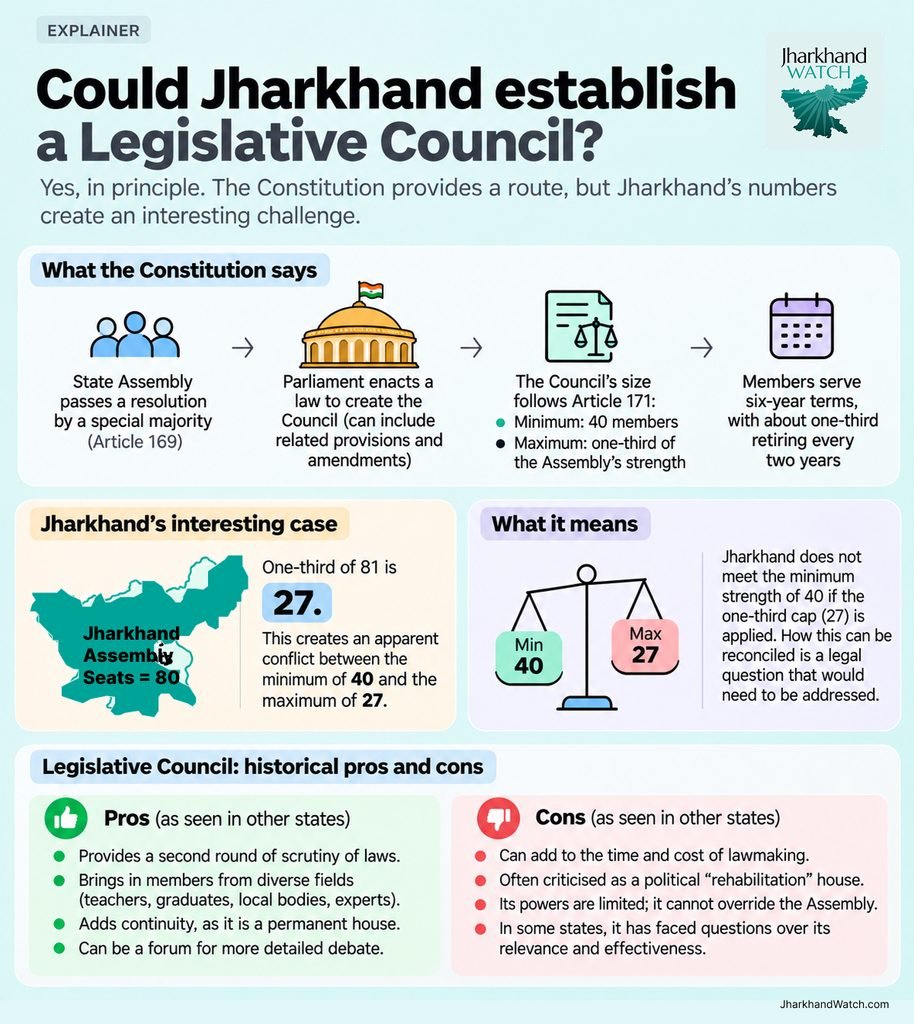
First, the Jharkhand Legislative Assembly would need to pass a resolution supporting its creation. The resolution requires a majority of the Assembly’s total membership and at least two-thirds of the members present and voting.
For an 81-member Assembly, the first condition means at least 41 votes. The second condition is calculated separately, based on members present and voting.
The resolution alone would not establish the Council. Parliament would then have to pass a law to create it. Article 169 also allows that law to include necessary constitutional amendments and related provisions.
There is, however, an interesting numerical question. Article 171 says that a Legislative Council cannot have more than one-third of the Assembly’s total membership, but cannot have fewer than 40 members.
For Jharkhand, one-third of 81 is 27. This creates an apparent conflict between the minimum of 40 and the maximum of 27.
Article 169(2) allows Parliament to include necessary constitutional amendments in the legislation creating a Council. Therefore, the numerical issue should not be treated as an outright constitutional bar. Any proposal would, however, need to address it through the legislation and necessary constitutional provisions. As far as records of Jharkhand Legislative Assembly discussions go, we haven’t found any record of discussion on creating a Legislative Council so far.
For now, Jharkhand has a single-house legislature. Whether the state should have a second house is a separate political and policy question. The Constitution allows it, but establishing one would require both a special-majority resolution in the Assembly and legislation by Parliament. And without the delimitation exercise, it looks a distant possibility, because the numbers are not enough to fulfil the criteria as of now.
Jharkhand Watch Monthly Newsletter
Independent reporting, explainers and data. Every Month. No spam.
AI Disclosure: Outline, structure and some headlines of this explainer were genrated using a LLM model. Infographics were assisted by a GenAI tool as well.
Edited and Fact-checked: Romil Javed
Last updated: 3 November, 2026