Independent journalism on Jharkhand’s politics, economy and society.

The Untold Story of Migration From Santhal Pargana

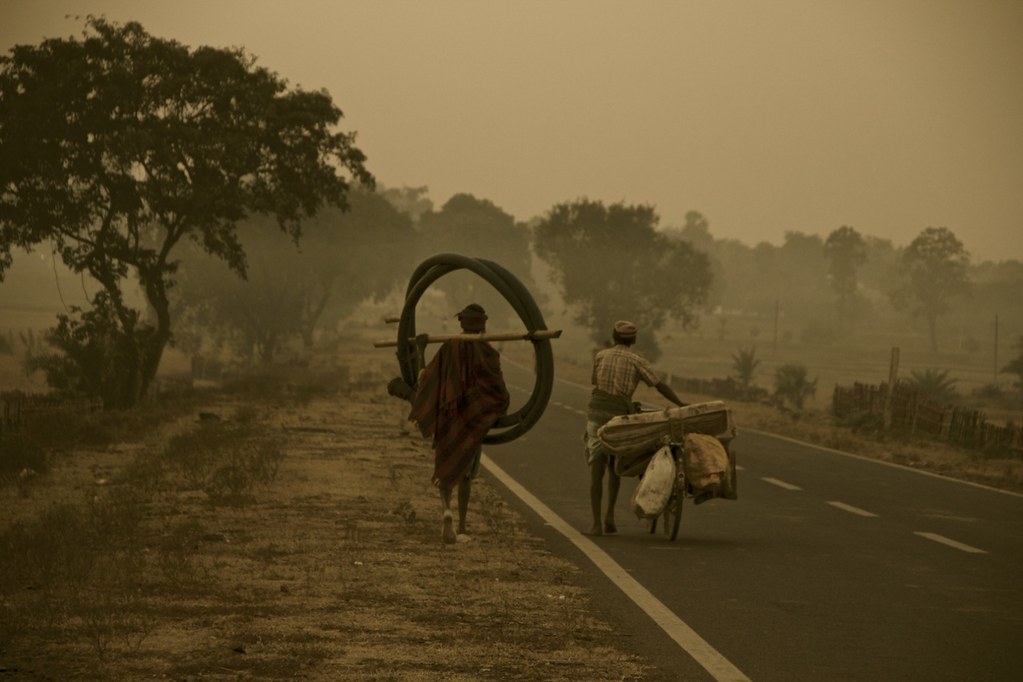
Every year, after the paddy season ends in Jharkhand’s Santhal Pargana region, thousands begin to leave.
Some board crowded trains from Sahibganj and Dumka towards Delhi, Punjab and Haryana. Others travel by buses to Bengal, Odisha and Assam. Young men leave for construction sites and factories. Women are recruited as domestic workers in metropolitan cities. Entire families migrate seasonally for brick kilns and agricultural labour.
For decades, migration from Santhal Pargana has remained one of eastern India’s least discussed social transformations — visible everywhere, yet rarely examined in depth.
While migration from Bihar and eastern Uttar Pradesh dominates the national imagination, large parts of Jharkhand, especially the Santhal region, have quietly experienced a long cycle of labour outmigration shaped by poverty, ecological stress, indebtedness and uneven development.
Today, researchers say migration is no longer just an economic phenomenon in the region. It is reshaping demography, culture, gender relations and even village life itself.
A Region That Sends Workers Out
Santhal Pargana — comprising Dumka, Deoghar, Godda, Pakur, Sahibganj and Jamtara — remains one of Jharkhand’s economically weaker regions despite significant mineral reserves and strategic geography.
According to Census data and multiple migration studies, Jharkhand has consistently recorded high levels of outmigration, especially among Scheduled Tribes and rural labour households. Within the state, Santhal Pargana has emerged as one of the major migration belts alongside Palamu and parts of Kolhan.
A 2017 study published in the Indian Journal of Human Development noted that migration from tribal regions of Jharkhand is increasingly linked not only to poverty but also to “distress-induced livelihood mobility” caused by shrinking agricultural viability and lack of local employment opportunities.
Researchers studying migration in Dumka and Pakur districts have found that migration patterns often intensify after monsoon crop cycles, creating what economists describe as “seasonal circulatory migration” — workers leave for several months and return during sowing or harvest seasons.
Tribal And Non-Tribal Migration: Different Histories, Similar Pressures
Migration in Santhal Pargana does not affect all communities in the same way.
Among tribal communities, especially Santhals and Paharias, migration has historically been linked to land fragmentation, forest dependence and low agricultural productivity. Many villages continue to rely heavily on rain-fed farming, making incomes vulnerable to irregular monsoons and climate stress.
Several academic studies have also documented the role of labour contractors — locally known as sardars or thekedars — in facilitating migration to brick kilns, plantations and construction sectors across India.
“Migration from tribal belts of Jharkhand often operates through informal labour networks rather than formal recruitment systems,” noted sociologist Surinder S. Jodhka in a broader study on migrant labour patterns in eastern India.
But migration is not limited to tribal populations.
Non-tribal communities in Santhal Pargana, including OBC and Dalit rural households, have also increasingly migrated due to unemployment, declining agricultural returns and limited industrial growth. In districts like Deoghar and Jamtara, migration patterns are now deeply tied to education aspirations and urban service-sector employment.
In many villages today, migration cuts across caste and community lines — though the forms of work and vulnerability often differ sharply.
How Santhal Pargana Compares With The Rest Of Jharkhand
Compared to industrial regions like Dhanbad, Bokaro or Jamshedpur, Santhal Pargana has historically seen lower industrialisation and weaker urban employment generation.
This difference matters.
Migration from mining belts in Jharkhand is often linked to industrial labour mobility, while migration from Santhal Pargana is more rural and informal in character.
A paper by the Institute for Human Development observed that migration from northern and eastern Jharkhand tends to involve:
- seasonal labour,
- construction work,
- domestic work,
- brick kilns,
- and agricultural labour in other states.
By contrast, districts around Ranchi and Jamshedpur show relatively higher levels of service-sector and education-linked mobility.
Government data also suggests that districts with weaker irrigation, lower industrial investment and higher rural poverty tend to record stronger distress migration trends.
Several blocks in Pakur, Sahibganj and Dumka repeatedly appear in studies on seasonal migration vulnerability.
The Invisible Economy Of Migration
Migration has quietly become one of the region’s largest economic systems.
In many villages, remittances from migrant workers now support:
- household consumption,
- education,
- house construction,
- healthcare,
- and local markets.
“Entire rural economies in eastern India are now partially dependent on migration income,” economist Jan Breman wrote in his work on informal labour migration.
Yet much of this economy remains invisible in official planning.
Many migrants work in informal sectors without contracts, insurance or legal protections. During the COVID-19 lockdown, the scale of this invisibility became dramatically visible as thousands of migrant workers returned to Jharkhand from cities across India.
Images of workers walking along highways or waiting at railway stations briefly pushed migration into national headlines. But researchers say the structural causes behind migration remained largely unchanged even after the pandemic.
Women And Migration
One of the least discussed aspects of migration from Santhal Pargana is the growing migration of women.
NGO reports and labour rights studies have documented increasing movement of young women from tribal districts into domestic work networks in Delhi, Kolkata and other metropolitan areas.
Activists working in Jharkhand have repeatedly raised concerns about:
- trafficking risks,
- exploitative placement agencies,
- wage theft,
- and unsafe working conditions.
At the same time, migration has also altered social roles inside villages. In some households, women now manage agriculture, finances and local decision-making while male family members remain outside the state for most of the year.
Researchers describe this as the “feminisation of rural responsibility” in migrant-sending regions.
Why Migration Continues
Despite decades of migration, the fundamental drivers remain remarkably persistent:
- low farm productivity,
- fragmented landholdings,
- weak irrigation,
- unemployment,
- poor rural infrastructure,
- and a lack of stable non-farm jobs.
Santhal Pargana’s geography adds another layer of complexity. Hilly terrain, forested areas and scattered settlements have historically limited large-scale industrial and infrastructure expansion compared to southern Jharkhand.
Some economists argue that migration itself has become normalised as a survival strategy.
In many villages, migration is no longer viewed as exceptional. It is expected.
Young men grow up assuming they will eventually leave for work outside the state. Entire social networks now revolve around destination cities, labour routes and contractor systems built over decades.
A Political Issue That Rarely Becomes Political
Despite its scale, migration rarely dominates electoral politics in Jharkhand with the same intensity as land rights, reservation or identity issues.
Part of the reason may be that migration is diffuse and slow-moving. Unlike a single industrial closure or land conflict, migration unfolds gradually across thousands of households.
Yet its long-term effects may be equally transformative.
Villages are aging. Agricultural labour patterns are changing. Aspirations are shifting rapidly among younger generations exposed to urban life outside Jharkhand.
Migration is no longer just a story about labour. It is becoming a story about what kind of society Santhal Pargana is slowly turning into.
AI Disclosure: This article is repurposed and summarised using a LLM model.
Edited and Fact-checked: Romil Javed.
Last updated: 10 October, 2026.